
Select your language
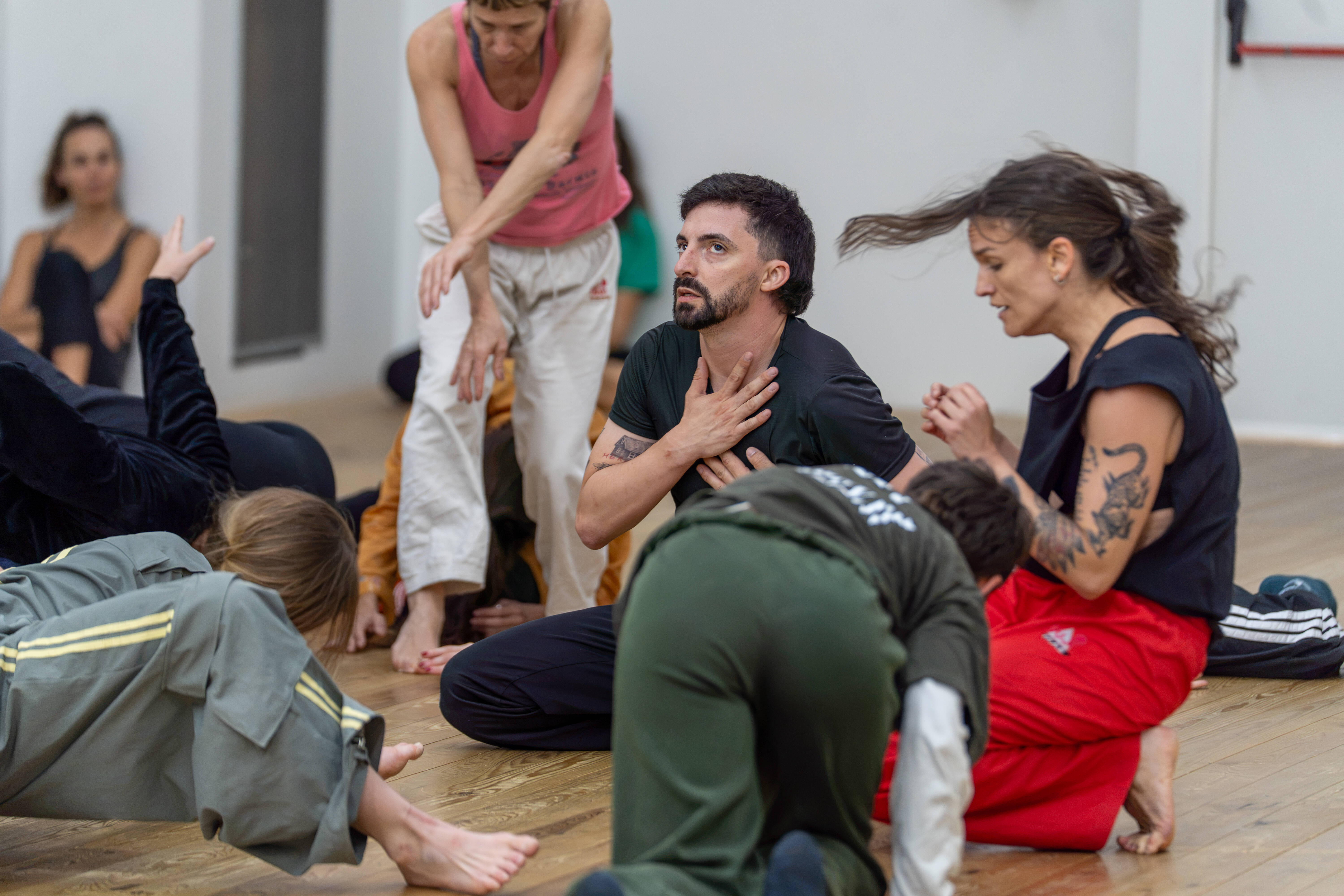
For our new blog post, we feature the voice of Bruno Duarte, who shares his reflections on the recent B>Meeting 2026. Bruno is a PhD Researcher in Contemporary Art at the University of Coimbra and the current resident choreographer of the Companhia de Dança de Almada in Portugal.
With a solid background that bridges academia, performance, videodance creation, and arts management as the technical director of the Quinzena de Dança de Almada, Bruno holds a comprehensive perspective on stage creation. His work has led him to share his vision and methodology in various corners of the world, from China and Brazil to Croatia.
In the following text, Bruno offers a very honest account of his time at La Caldera. He talks about how the design of the meeting's dynamics allowed him to let go of his introversion, dismantle traditional "networking" barriers, and find in vulnerability and shared movement a way to rethink his own corporeality and connect deeply with other creators.
Before arriving in Barcelona for the B>Meeting 2026, my expectations were a deliberate blank slate. Colleagues who had previously attended the event purposely kept their descriptions vague, a protective silence designed to let me experience the week as organically as possible. I arrived relatively prepared, yet wonderfully devoid of fixed ideas.
The experience began the moment I stepped into La Caldeira. As a practitioner, I am acutely aware of how space informs the body, and the building itself immediately struck a chord. The sheer beauty and curation of the space set a welcoming tone for the days to follow.
I have never been, firsthand, a naturally outgoing person. In professional settings, I often find it challenging to initiate conversation, present myself, or navigate the typical "networking" small talk. Yet, the true brilliance of the B>meeting lies in its structural choreography. The entire program is designed to dismantle these social barriers, allowing encounters to manifest organically. From the vulnerable exercise of reading another artist's statement aloud as if it were our own, to the rapid-fire one-minute "speed dating" introductions, and the all-encompassing B>Labs, the environment fostered a natural state of openness. As the week progressed, I found myself shedding my usual introversion. For the first time at a festival of this scale, I spoke directly with every single participant, a small personal triumph that felt incredibly liberating.
The practical work within the B>Labs was a continuous exercise in shifting perspectives. Each lab was radically different. While some proposals introduced completely foreign methodologies, others dealt with concepts I was already familiar with. However, the sheer multiplicity of bodies and minds working together meant that my approach to even the most familiar material was entirely disrupted and rebuilt. Observing how uniquely each person inhabits a proposal granted me a 360-degree vision of the creative process.
It was a profound reminder of the creative reflective practitioner concept, where shared exploration directly recalibrates our individual artistic practice. In a deliberate attempt to push my own boundaries, I enrolled in a lab directed by Nina, focused on sensuality, the "sexy," the erotic and explicit thought. Stepping outside my comfort zone proved to be the most transformative decision of the week. The masterfully guided sessions and the vital conversations that surfaced allowed me to connect with the other participants on a deeply profound level. The impact was not merely professional- it provoked a visceral re-evaluation of my own self-awareness. It altered my perception of my body, not just as a dance practitioner, but as a person.
Ultimately, BIDE acts as an accelerator for human and artistic constellations. The sheer volume of genuine connections I made was staggering. I leave Barcelona with peers who I am certain will remain long-time friends, and I am already in contact with several for future collaborations.
But perhaps the most beautiful realization of the week was how these bonds were forged. These relationships were not solely built during the verbal sessions where we articulated our work. Instead, they were constructed in the highly sensitive, wordless moments of shared motion. It was a powerful reaffirmation of a shared physical empathy, an electricity that passes seamlessly from one body to another when we allow ourselves to truly inhabit the space together.
